1. Magic Spray
Kids have the tendency to get injured in every opportunity possible. About 90% of their injuries are trivial, but their screaming and yelling try to convince you otherwise. You can probably recall a few instances when you’ve witnessed a kid trip over their own feet – then they get up slightly stunned, but not crying or screaming. At their first glimpse of blood the silence instantly disappears. Luckily, the placebo effect works on kids 95% of the time. Small kids can’t take sugar pills so you can create your own placebo. Just take an old spray container, fill it with water, and label it, “Magic Spray.” Then create some story about how you found it in a magic cave and how it heals all wounds. Spray it on the kid’s injury and watch them magically stop crying!
2. Imaginary Super Hero
Kids have an over active imagination, sometimes it actually scares them. Some variation of a Boogie Man could keep them up at night. If it’s not helping to simply tell the kid there is no such thing, then you need to make them stop thinking about it all together. Tell them to imagine the biggest and strongest super hero imaginable. Every time their bad thoughts pop up, tell them to imagine their super hero crunch up their thoughts like a piece of paper and throw it away in a trash bin. And remind the kid that the super hero has super speed and will never waste time to destroy their bad thoughts.
3. Superstition
Sometimes you just don’t have the time to explain to a kid why they should stop a certain behavior. For example you are at the supermarket and it’s your turn to pay for your groceries when your child starts opening candy bars. You don’t have time to lecture them so just say it’s bad luck. Kids will obey any superstition thrown at them... for about one minute. The one minute will give you enough time to pay for your groceries and will stop the kid’s bad behaviors momentarily.
4. Operation Hopelessness
Have you ever had your child ask you for just one more quarter for the arcades? And after you give them that quarter they run back to ask for another? To stop this aggravating behavior you must hinder their persistence. Make a huge fuss about how you don’t want to give them another quarter (or any other object they want). Then after about five minutes you finally give them the quarter. They will use it up in a matter of seconds and come back discouraged to beg for another. This way you save yourself half an hour dealing with an angry and tireless kid.
5. Embarrassment
Ever have your teacher write your name on the board because you were talking in class? This is a widely used strategy because it works. It is effective because it’s embarrassing and singles you out. If you are in a public place with a child who is out of control, give him the attention he doesn’t want. Yell out their name loud enough for others to hear and sustain a loud voice if they continue misbehaving. If you don’t want to embarrass yourself in the process, just threaten them with embarrassing things you’ll do to them.
Friday, September 14, 2007

Friday, August 24, 2007
An Alternative for Age Requirement Laws
We all love to hate America’s drinking age requirements. Everyone is familiar with this argument,
“If we can choose to die for our country at 18, shouldn’t we be mature enough to choose to drink alcohol?”
Whenever a lot of people preach the same one-liner argument, I switch into skeptic mode. There is a good chance the majority of people saying this one-liner are emotionally attached to their position. If you are 18 and cannot find anyone to buy you alcohol for a party, you are going to concur with like-minded opinions, especially the ones that are easy to understand.
What is this argument really about? Does it show the ridiculousness of government age regulations or something else? There is obviously a certain age that people reach when they are mature enough to make a particular decision. A 5-year-old is not mature enough to decide to drink alcohol, and therefore shouldn’t be given the right to buy alcohol. What about a 6-year-old? Or 7-year-old? Eventually you will reach an age when that person is mature enough.
The government is faced with a problem, they know there exists an age where a person is mature enough to make certain decisions, but at what age should they set the law to? Quantifying the age of maturity for a country as a whole is impossible. The average age of maturity varies in every state, region, or even county!
This brings me to my next point, who should have jurisdiction on age regulation? In my opinion this jurisdiction should be delegated to individual cities. There could be some company that assesses the average age of maturity in a city. This assessment will include the demographics, the violence rate, number of young people, teen drunk driving incidents, etc. Then each city can decide upon an appropriate age of maturity. This could be a good incentive for cities to be safer. If your city has lower age requirements, more people might move there and therefore house prices go up.
Thursday, August 9, 2007
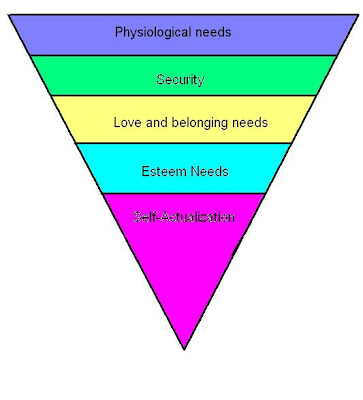
Maslow's Hierarchy of Needs [American Version]
The American version of Maslow's Hierarchy of needs.
Steps:
1. The foundation of this pyramid is Self-Actualization. An American must satisfy this step before they can move up the hierarchy. The American usually grows up in a comfortable atmosphere where food, shelter, and clothing are in abundance. At this point in time the young American has no struggles. All he can do is ponder the artificial meanings of life that the American culture has brought to them.
2. The American child quickly realizes that they need to look like a celebrity if they want to retain self-actualization. Once makeovers, manicures, and pedicures are all taken care of, the American dwells in promiscuity. Once the need to be with many partners is fulfilled, the American can move up a step in the hierarchy.
3. After countless break-ups and hook-ups, the American desires to settle down with a unique individual. The American seeks love, as opposed to just sex, from this individual. Marriage finally takes place to sanction their love for one another.
4. When an American family is created, they seek top security; nothing can come in the way of the nuclear family. The family will make sure they don’t live in a godless society that may otherwise put the family in danger. They will also vote for the politician that promises the best homeland security.
5. The last step of the hierarchy, and the most desirable place to reach, is the physiological needs. Once the lower levels have been fulfilled, the American will start to take care of their body. The average American only reaches this step at around forty years old. They realize their body has taken a beating by the years of promiscuity and starvation diets. The sooner the American reaches this step, the sooner happiness will take into effect.
Now, a fun exercise for my readers: try to imagine what the American food pyramid looks like.
Wednesday, August 8, 2007
Mini Freakonomics
1.The Poor Baker’s Dozen
Ever wonder why donut places offer you one free donut in a dozen donuts? What additional satisfaction does the customer get with one extra thirteenth donut? In my local bakery, a dozen donuts costs me $6.00 and a single donut costs 75 cents. The customer’s value on the donut decreases with every additional donut. The value of one donut may start off at 75 cents, but by the thirteenth donut the value reaches around 20 cents (assuming the value decreases linearly by about 4 cents).
This means that the bakery is taking a loss by adding the thirteenth donut. The only reason they would add the thirteenth donut is if it was a big enough incentive (a mighty 20 cents of value) for their customers to buy more donuts.
Here is a question for you, would an extra thirteenth donut make you want to buy a dozen donuts when you otherwise wouldn’t have? No it wouldn’t, and that is why the baker’s dozen is a stupid business invention.
2. Halloween, A Night of Horrifying Economics
Halloween is that time of year where millions of dollars of candy don’t get optimized. A large percentage of the candy kids get is not wanted and thrown away. There should be a “National Halloween Free Trade Market,” that opens up the week following Halloween. This will allow kids everywhere to trade candies they don’t like for those they do like.
3. Party Goers Might be Superficial
People who go to parties or clubs on a regular basis to meet a mate are more likely to be superficial. When you go to a social scene like this, you are exposed to many potential mates. You would need to narrow down your choices in a matter seconds! Choosing the right person to ‘hit’ on in the pool of potentials may be a superficial process. You must point out superficial qualities in a person because you don’t have time to get to know everyone. This superficial selection attribute may spill over to your daily life. A potential mate at work may be shot down before you ever get to know each other.
4. Religious People More Likely to be Racist
By religious people, I mean people who identify themselves as the same religion as the one they were raised to be. The same qualities reside in both religious people and racists.
Both:
- Have faith that their beliefs are correct.
- Have no evidence to justify their beliefs.
- Refuse to open themselves to new perspectives on their beliefs.
- Don't allow logic to interfere with learned behavior/thoughts.
- Feel more in touch with peers when practicing beliefs.
This correlation may be off because there is a much stronger stigma to be racist than religious. The possibility is increased because they have the prerequisite characteristics of a racist.
5. Music Artists Finally Get Paid What They Deserve
The record industry has reached the lowest point in history. This would make song artists pissed off because now they don't make as much money. They shouldn't be pissed! They are finally receiving the amount of money they always deserved.
CEOs make a lot of money because their skills are in short supply and highly demanded. Now a day, all you need to be successful in the music industry is an excellent marketing team and a sufficient budget. The amount of people with an adequate amount of music skill is not in short supply. Now the song artists will receive a more accurate amount of money their skill deserves.
Monday, August 6, 2007
How to Judge a Girl's Attractivness
Imagine you are in a Starbucks with a gossip buddy and one of you spots a girl who looks like she came back from a Paris Hilton convention. Her face has enough makeup to protect her skin from a powerful laser. Her skirt is so short she couldn’t hide a paperclip between her legs. You whisper to your friend, “Jesus, I bet she is disgusting behind all that glamour gear.” Then your friend replies, “Yea, um, I would still hit it.”
In this case, who is making a better judgment on the attractiveness of this Paris impersonator? I would argue that your friend would have the better judgment.
There are two extreme ways of judging a girl’s attractiveness. 1) Judge how she looks in the worst lighting and the worst camera angles. 2) Judge how she looks in the best lighting and the best camera angle. Both ways offer a fair platform to scrutinize and compare her looks with others. There are two things wrong with making these judgments. Firstly, the majority of the time you won’t see this girl in the worst or best possible way, so you have to judge her somewhere in between. Secondly, consider two girls, girl X looks better than girl Y in the judgment analysis 1. However, girl Y looks better in the judgment analysis 2! This contradiction leads me to believe that there is no objective way of judging the attractiveness of a girl.
Now lets analyze the attractiveness of the Paris Hilton wannabe. Considering that she walked into a Starbucks with how she was dressed, it is probably how she looks like the majority of the time. If both of you agree that she is hot at that moment, then she becomes officially hot.
Disregard everything above if you are drunk.
AI is Blind
Everyone has seen the movies where robots live amongst organic beings like ourselves. As technology increases exponentially, many people believe this will soon be reality. As awesome as it sounds to have robot slaves wipe your ass (ethics aside), it is still a far-fetched idea. How would the robot be able to identify your ass instead of another cushioned semi-sphere?
Vision in humans is a highly complicated mechanism. We evolved to symbolically respond to the objects we see. When we see a photo of a loved one, our brain is triggered emotionally rather than just computing the photo as geometric shapes. We also evolved to see symbols in objects that barely have resemblance to reality. We see faces where none exist, like this smiley face =).
A funny example when this adaptation fails:
 Would a robot be able to make this same mistake? It may be possible to have its or his AI strong enough to make the mistake, but it seems unlikely to be invented in the near future. This is partially why making a self-driving car is so convoluted. How could its AI identify an old woman driving in front of it? In which case it would have to tailgate until she pulls over. On a more serious note, there are many instances where symbolic human vision is needed.
Thursday, July 19, 2007
The Smart Person Fallacy
Logical fallacies are useful tools in putting to sleep arguments that aren’t going anywhere. In other words, logical fallacies are “Argument Euthanasia Tools (AETs).” The only problem with these AETs is that there aren’t enough of them to go around. With only a measly fifty or so fallacies, there are thousands, even millions of arguments that aren’t killed (against the will of their creator).
In response to such an unsettling dilemma, I have discovered a new logical fallacy that is often breached. This fallacy is called The Smart Person Fallacy ™.
In our everyday life, we find it logical to expect people to behave in the same manner as they always have. It would be illogical to suspect that my best friend is going to rape me every time I get shotgun instead of him. Based on my past experience with him, he doesn’t seem like the type who would rape another man out of spite.
Now let us assume that a person’s past behaviors include them to be right all the time. It would then be illogical to not give this person the benefit of the doubt. Lets say that I am teaching a 4th grader simple arithmetic. I solve every problem in his booklet flawlessly (yes, even the bonus questions). There is one more problem I haven’t completed yet, and I have the 4th grader give it a shot. He says the answer is 6 chickens, but I proclaim it is 10 chickens. If the 4th grader gives himself the benefit of the doubt, he is exercising the The Smart Person Fallacy ™.
A good example of where the The Smart Person Fallacy ™ is used most often, is with the issue of evolution. On one side of the argument you have intellectuals like Richard Dawkins and on the other side you have bible thumping baboons (usually found in warmer climates in the South and rural areas). For these half-wits to disagree with Dawkins about God, is a prime example of The Smart Person Fallacy ™. Not giving Dawkins the benefit of the doubt on an issue he knows all too well is illogical.
With this new fallacy, hopefully we can put to sleep arguments that seem to be in a vegetative state.
Subscribe to:
Posts (Atom)